Drip, Pod, Espresso or Pour-Over? Choosing a Coffee Maker for How You Drink
The best coffee maker is the one that matches your morning. A straight comparison of four methods by taste, effort and cost per cup.
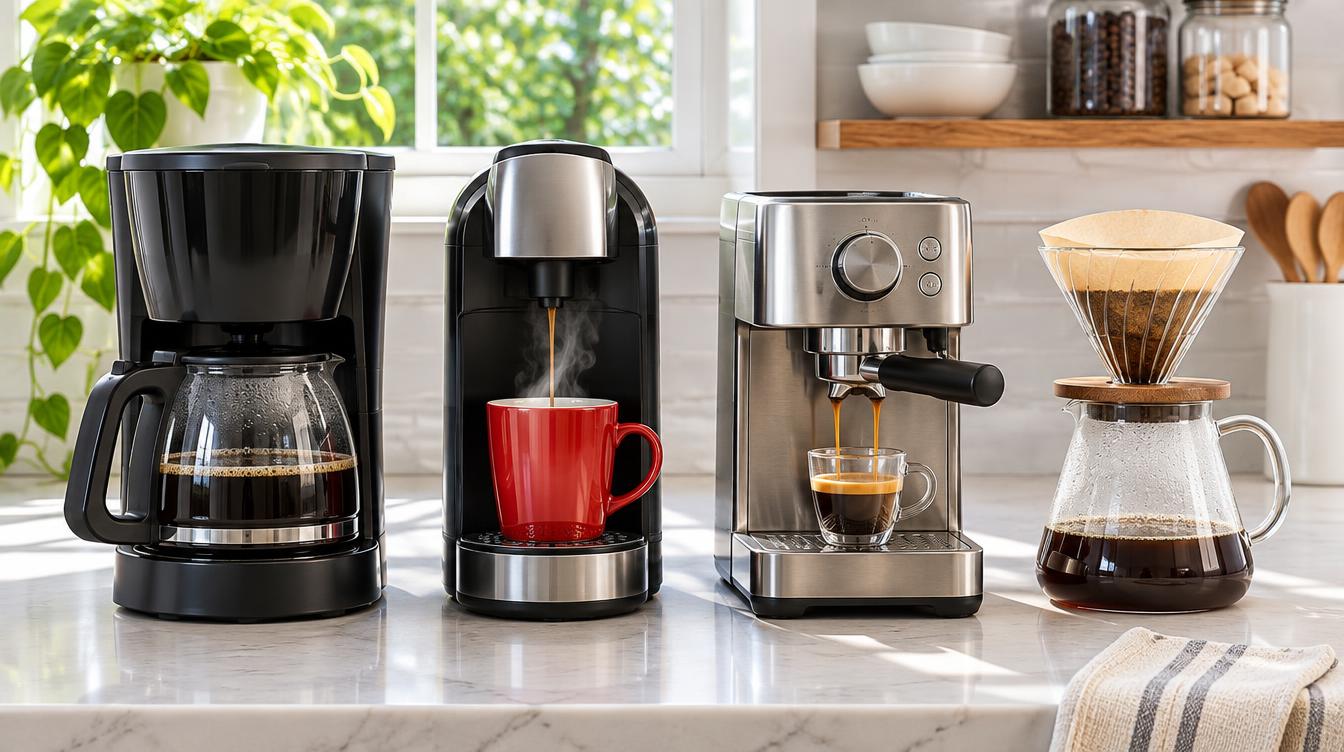
- Choose by habit: drip for several cups, pod for speed, espresso for milk drinks and a hobby, pour-over for the best cup at the lowest price.
- Freshly ground beans improve any method. A burr grinder is the upgrade that matters most.
- Pods are the most convenient and usually the most expensive per cup.
Coffee is a daily ritual for most households, which makes the machine that produces it one of the most-used appliances in the kitchen. It also makes the wrong choice a daily irritation.
There is no best coffee maker. There is a best one for the way you drink coffee: how many cups, how quickly, with or without milk, and with how much patience at seven in the morning.
Start with your routine
Before looking at machines, answer four questions honestly.
- How many cups does the household drink each morning?
- Do you want it in one minute, or will you happily spend five?
- Do you drink it black, or with steamed milk?
- How much cleaning will you really do?
The answers narrow the field faster than any feature list.
| Method | Best for | Effort | Typical cost of machine |
|---|---|---|---|
| Drip | Several cups at once | Low | Low to moderate |
| Pod | One cup, instantly | Lowest | Low to moderate |
| Espresso | Lattes, cappuccinos, enthusiasts | High, or low with an automatic | Moderate to very high |
| Pour-over or French press | The best cup for one or two | Moderate | Very low |
Drip machines
The automatic drip brewer is the workhorse. Add water and ground coffee, press a button and return to a full pot.
Good drip coffee depends on water temperature. The ideal brewing range is roughly 195 to 205 degrees Fahrenheit, and many inexpensive machines never reach it. Some brewers are independently certified to brew within that range, which is a useful mark to look for.
Choose a thermal carafe over a glass pot on a hot plate. A hot plate keeps coffee warm by continuing to cook it, and after twenty minutes it tastes like it.
Pod machines
Pod machines trade everything for convenience. Insert a capsule, press a button, drink. There is no measuring, no grinding and almost no cleaning.
The coffee is consistent and, to many palates, less fresh than coffee ground on the spot. It is also the most expensive way to make coffee at home, cup for cup.
Pods do not make the best coffee. They make the easiest coffee, and at 6.30 a.m. that is sometimes the same thing.
Packaging is the other cost. Look for systems whose pods can be recycled where you live, or consider a refillable pod.
Espresso machines
Espresso forces hot water through finely ground coffee under pressure, producing a small, concentrated shot. It is the base for lattes, cappuccinos and flat whites.
There are three broad kinds of machine. Manual and semi-automatic machines give you control and require practice. Fully automatic bean-to-cup machines grind, dose and brew at the touch of a button and cost considerably more.
With a semi-automatic machine, the grinder is as important as the machine itself. Espresso is unforgiving of an uneven grind.
Be realistic about the commitment. Espresso involves a learning curve, daily cleaning and regular descaling. For those who enjoy it, that is the pleasure.
Pour-over and French press
The simplest methods need no machine at all. A pour-over dripper is a cone that holds a paper filter. You pour hot water over the grounds by hand.
A French press steeps coarse grounds in water and filters them with a plunger. It produces a fuller, heavier cup.
Both cost very little, take up almost no space and, with good beans, make coffee as fine as anything from an expensive machine. They ask for a few minutes of attention and a kettle.
What a cup really costs
The price of the machine is paid once. The price of the coffee is paid every morning.
For a household drinking four cups a day, the difference between pods and drip adds up to several hundred dollars a year. Any of them costs a fraction of a daily visit to a coffee shop.
The grinder question
Roasted coffee begins losing aroma the moment it is ground. Grinding just before brewing is the most reliable way to improve what is in your cup.
Blade grinders chop beans into uneven pieces. Burr grinders crush them between two surfaces to a consistent size, which leads to even extraction and better flavour.
A modest burr grinder paired with an inexpensive brewer will beat an expensive brewer fed with stale pre-ground coffee.
Features that matter
On a drip machine: a thermal carafe, a showerhead that wets the grounds evenly and a programmable timer if you want coffee waiting when you wake.
On a pod machine: the range and price of compatible pods, and the size of the water tank.
On an espresso machine: stable temperature, a capable steam wand and, for beginners, a built-in grinder or a pressurised basket that forgives mistakes.
Features that do not
Dozens of drink presets, colour touchscreens and app control rarely improve the coffee. A built-in milk frother on a cheap machine is often harder to clean than it is worth.
A separate handheld or jug frother costs little and does the job well.
Counter space
Measure before you buy. Espresso machines and bean-to-cup models are deep and heavy, and many need clearance above for filling the water tank or bean hopper.
If space is short, a pour-over cone and a kettle take up less room than a toaster.
Matching machine to drinker
A household that wants a pot ready at seven: a drip machine with a thermal carafe and a timer.
One person, one quick cup: a pod machine, or a pour-over if two extra minutes are acceptable.
A lover of milk drinks with patience to learn: a semi-automatic espresso machine and a good grinder. The same person without the patience: a bean-to-cup automatic.
Someone who simply wants the best black coffee for the least money: a pour-over cone, a burr grinder and fresh beans.
The brief
Buy for your real mornings, not your imagined ones. Spend on a grinder before spending on a machine. Clean it regularly.
Get those three right and almost any method will give you a cup worth getting up for.
Frequently asked questions
What type of coffee maker makes the best coffee?
With fresh beans and a good grinder, pour-over and well-made drip brewers produce excellent filter coffee, and a properly used espresso machine makes the best espresso drinks. The quality of the beans and the grind usually matters more than the machine.
Are pod coffee machines worth it?
They are worth it for people who value speed and convenience and drink one or two cups a day. The coffee costs more per cup than other methods and creates more packaging waste, though reusable and recyclable pods are available for many systems.
Do I need a grinder?
You do not need one, but it is the single biggest improvement you can make. Coffee loses aroma quickly after grinding. A burr grinder, which produces even particles, makes a noticeable difference with every brewing method.